

Why we should be teaching children outside more often
Urban schools, real classrooms and the science behind calmer, more focused kids

This is part of my Nature Deep Dive series in which I unpack the science behind nature connection.
Research is often inaccessible because of jargon and assumptions of prior knowledge. This shouldn’t be the case. Everyone has the right to know what we know. Knowledge is power, after all. AI can’t interpret and contextualise research for you, but I can.
That’s why I read science papers that won’t make it into the media but should, so you don’t have to.
Dear friends,
This month, I’m looking at research on outdoor learning. Does outdoor learning, even in an urban environment where there is less nature around, still reduce children’s stress?
We know well enough now that being in a green, nature-rich setting can improve our wellbeing and reduce our stress levels. For children, we know it can improve their activity levels, social interactions, focus and ADHD symptoms.
But what about when children are outside for their lessons in an urban environment? That’s not to say they are exposed to no nature at all, but certainly to less than you might expect in an idyllic, rural school playground. In this situation, is it still worth learning outside?
That’s what this month’s paper decided to find out:
‘Outdoor learning in urban schools: Effects on 4–5 year old children’s noise and physiological stress’
I love this study because the researchers gathered data from children at their actual schools. I love how they worked with teachers and kids to design this experiment around the school day, which means what they found out can be directly applied and acted upon, rather than having to be adapted from some strange clinical setting.
It also has a really solid study design, which is frustratingly rare in the field of outdoor learning research.
I first came across this paper when one of my own studies, in which I was collecting heart rate data from school children, was under review by a journal. One of the reviewers was dubious about whether collecting this info from children during lessons was in any way reliable and asked if I could find a precedent for this. So I sent them this paper in response, in which they work with 4-5-year-olds (not the comparatively adult 11-16-year-olds I was working with) and had managed to get an excellent dataset. This felt satisfying.
What did the researchers do?
Put simply, the researchers measured children’s resting heart rates and levels of fidgeting during almost identical lessons inside and outside, as well as the noise levels in each of these environments during class.
We know that higher heart rates are indicative of higher stress and that more fidgeting and noise suggests less focus, so their question was ‘When children have a lesson outside, are they less stressed or more focused than when they have the same lesson inside?’
This research happened across four state-funded primary schools in the London Borough of Newham, where they worked with 76 children, all in Reception, which means they were all aged 4-5. All children took part in eight indoor lessons and eight outdoor lessons, with data collected four days a week for four weeks.
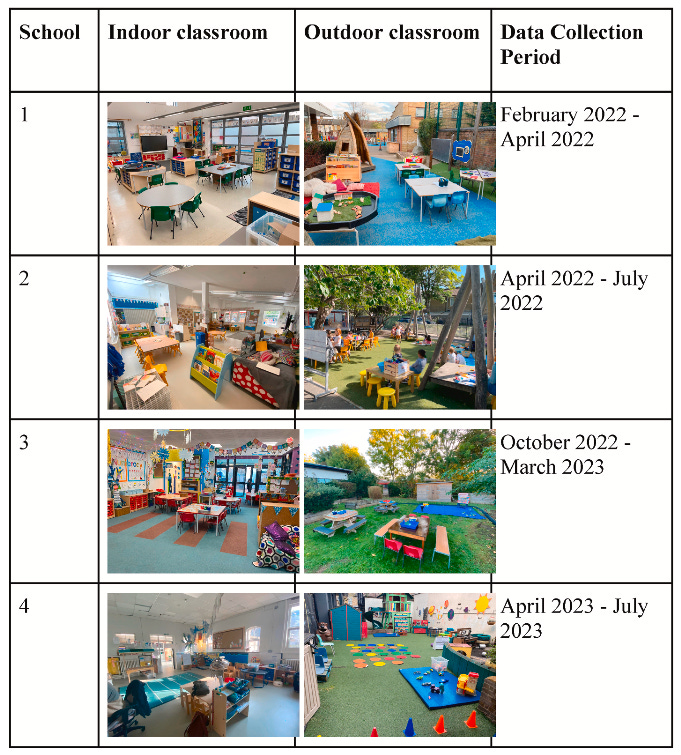
At each of the four schools, they created an outdoor classroom that replicated the indoor classroom as best as possible: they marked out the same size area outside, used furniture and resources directly from the indoor classrooms, and didn’t make use of any equipment that couldn’t be replicated in the alternate environment (e.g., interactive whiteboards couldn’t be recreated outside so they weren’t used inside, and vice versa with climbing frames and slides).
In other words, the researchers tried as hard as possible to make the only difference between these classrooms whether they were outdoors or indoors.
You can see photos of each of the outdoor and indoor classrooms at the four schools below, and I hope you agree, they’ve done a pretty good job:
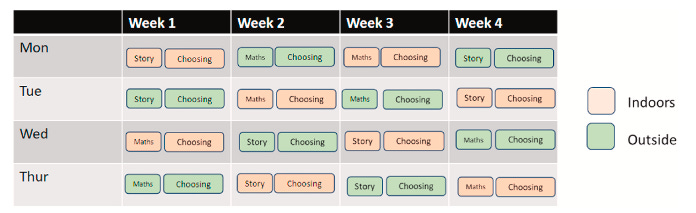
Each lesson consisted of two parts: ‘carpet time’ and ‘choosing time’. Carpet time was—you guessed it—when all the children sat on a carpet to listen to their teacher either read a story or teach a maths lesson. Choosing time was when children could pick between several activities (puzzles, drawing, play doh, for example). Among the eight lessons for each class given outside and the eight given inside, half included a maths lesson and half included a story in the carpet time section.
If you’re more of a visual person, take a look at the example timetable below, which should clear things up:
Each lesson lasted for 35-40 minutes, during which time all the children wore a specially designed, compact piece of kit under their tops, which measured heart rate and the amount of ‘micro-level movements’ (a fancy way of saying ‘fidgeting’). To measure noise levels, researchers placed a decibel meter at the centre point of each of the indoor and outdoor classrooms, which they set up to take a total of nine readings during each carpet time and each choosing time, allowing them to work out an average noise level for each part of every lesson.
This kind of experimental set-up in education and outdoor learning research is so rare! No snub to researchers here—it’s simply very hard to work schedules like this into already packed and rigid school days, with overworked and tired teachers. So the information we get from these kinds of studies is worth its weight in gold.
The specific questions the researchers set out to answer, armed with their beautiful dataset, were as follows:
Was there a difference in children’s resting heart rates during carpet time between the indoor and outdoor classrooms?
Was there a difference in the amount of fidgeting during carpet time between the indoor and outdoor classrooms?
Was there a difference in noise levels during carpet time between the indoor and outdoor classrooms?
Was there a difference in noise levels during choosing time between the indoor and outdoor classrooms?
How did noise levels affect children’s resting heart rate, and was this different between the indoor and outdoor classrooms?
What did they find?
Let’s look at the results for each of their specific questions in turn.
1. Was there a difference in children’s resting heart rates during carpet time between the indoor and outdoor classrooms?
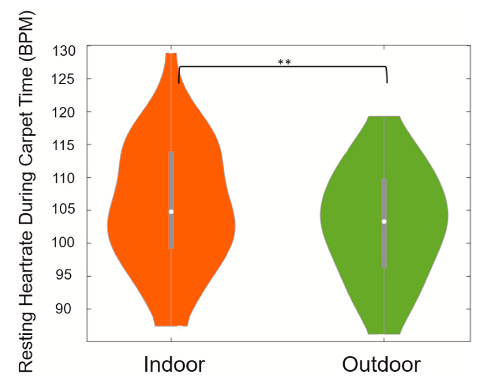
Yes! Resting heart rate was significantly lower during carpet time outdoors than indoors. Curiously, this didn’t seem to be affected by class or school, which suggests that the drop in heart rate was purely down to being outside, rather than to specifics of the school, class or time of year in which the data were collected.
Below is a violin plot that shows this result, so called because the coloured bits tend to look a bit like violins. The white dot at the centre of each ‘violin’ is the median value (in this case, of resting heart rate), the grey lines show the interquartile range of the data (which is where the middle 50% of datapoints lie), and the coloured shapes show the distribution of the dataset—i.e., the wider the ‘violin’, the more datapoints are clustered here. The black bracket with asterisks at the top tells you that the difference between the indoor and outdoor data was statistically significant.
2. Was there a difference in the amount of fidgeting during carpet time between the indoor and outdoor classrooms?
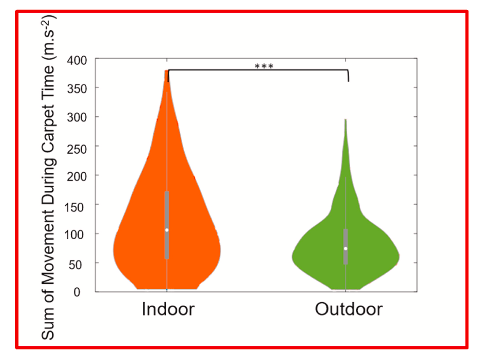
Also yes! Again, there was significantly less fidgeting during carpet time outside than inside, and this effect didn’t seem to be impacted by the individual child—i.e., this seemed to be true across all children.
Behold—a second violin plot that shows the second result. The extra asterisk on this one means the difference was even more significant.
3. Was there a difference in noise levels during carpet time between the indoor and outdoor classrooms?
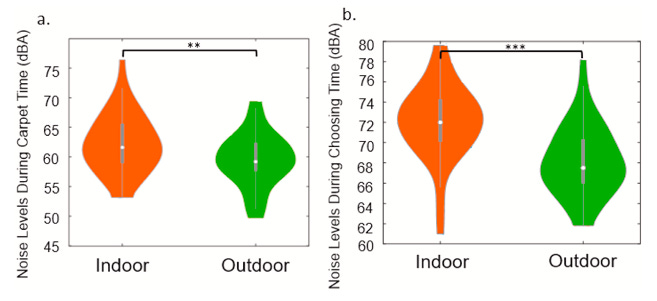
Indeed there was. There were lower levels of noise during carpet time outside than inside, suggesting greater focus on the story or maths lesson at hand.
4. Was there a difference in noise levels during choosing time between the indoor and outdoor classrooms?
There was also less noise during choosing time outside than inside—the part of the lesson you might expect to be a little rowdier than seated carpet time. Looking at the graphs below, it does indeed seem that choosing time was generally louder than carpet time, but, crucially, both parts of each lesson were quieter outside than inside.
5. How did noise levels affect children’s resting heart rate, and was this different between the indoor and outdoor classrooms?
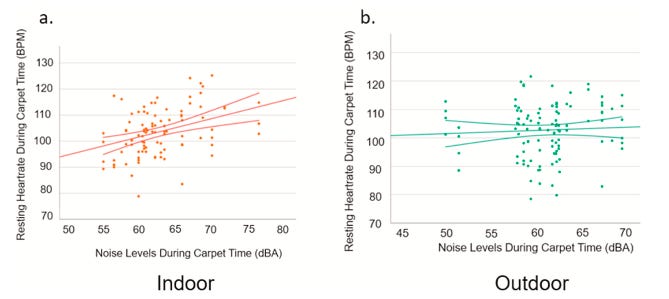
Finally, children’s resting heart rate increased along with increased noise levels. Interestingly though, this positive correlation was only significant in the indoor classrooms but not the outdoor ones. This suggests that being outside buffers some of the increased stress that noisier environments can lead to.
You can see this in the scatter plots below. The dots are the datapoints, and the straight line drawn through them is the line of best fit, meaning it’s showing you the correlation between heart rate and noise levels. You can see that this line slopes upwards on the ‘Indoor’ graph, showing a positive relationship, but that it is more or less horizontal on the ‘Outdoor’ graph.
In summary then, it seems that children were less stressed and more focused when they had their lessons outside, given that their resting heart rates, fidgeting levels and noise levels were all lower outdoors than indoors.
Why do we care?
This is where plenty of us will think ‘Obviously! Why do we need research to tell us this stuff?’ I agree. It is maddening. But it seems we do need it.
In past decades, this might have been less crucial—not just lower down the list of priorities for education boards but not even featured. Children were able to roam more freely around their homes and more likely to walk to school, all of which allowed them to be outside and exposed to nature much more frequently, in a way that was baked into their daily routines. Schools, too, were less pushed for space and places, and so could dedicate more space to outside, green areas, rather than indulging the modern tendency towards tarmac and climbing frames.
In this context, it makes perfect sense to teach every single lesson inside, avoiding the unpredictable nature of weather and making sure access to whatever stationery and resources needed was straightforward. It was less of an obvious problem, since children encountered time outside and nature on a much more regular, organic basis.
But somewhere along the way, we decided that taking children outside is complicated, lots of effort and only leads to them running around anyway. Now that children’s lives do not look like they once did—home ranges have shrunk, journeys to school are less likely to be on foot, home environments are less likely to be green—we need to be thinking about how best to counter this while they’re at school.
How can we best compensate for this lack of outside time and space to allow children to learn better and enjoy their education? What tweaks can we make to help them remain less stressed out and more focused during class—conditions, which, I’m sure you’ll agree, are likely to make learning easier?
Clearly, providing schools and teachers with the resources, space and training needed to take lessons outside on a regular basis should absolutely be on the list of solutions here. So often, when I talk about ‘outdoor learning’, people immediately think of forest schools, which is fair enough—they are fantastic—but that is a whole other conversation. We can also just take a lesson outside, with books, pencils, pens—all the traditional paraphernalia. The outside is an excellent place to learn about anything, even in a conventional way.
I’m grateful this kind of research exists. There are people working so hard in this area, gathering good-quality data that backs up what so many of us suspect but often presume isn’t being examined in a systematic way.
But this research needs to be listened to, and for that it needs to be known about. Go forth and spread the word!
Full credit to the authors of this paper: Gemma Goldenberg, Molly Atkinson, Jan Dubiel and Sam Wass. If you would like to read the full paper, click here.
If you want to learn more about the science behind why the outside is good for us, would you consider upgrading to paid or buying me a coffee? It allows me to keep writing.
Brilliant work on the research, and thank you for bringing this to our attention.
Soo many things seem obvious, such as the results of this one. But in order to convince people that this is a better way of doing things, we need the research, to prove them it's not just an opinion, but actual facts!
My most recent project was a compassion/humane education program where I worked with a professor to get a study done to measure the impacts on kids empathy scales. In the animal welfare field, I’m still amazed more school research is not done in large scales to help us cater to children’s (human) natural tendencies - love, nature, compassion, coexistence, harmony. I love that you break this down!!